Build a Polkadot Product
Get the Polkadot App
The Polkadot App is your wallet, identity, and signer: the center of everything you build. Install it first; every path below connects through it.
Then Pick Your Path
-
Guide Deploy a Product in Under 15 Minutes
Go from nothing to a live
.dotProduct: in your browser with RevX, or from the terminal with the CLI. No local environment to set up. -
Guide Develop Locally (the Full Route)
Install Polkadot Desktop, pair it with your phone, and get TestNet tokens, then build your Product capability by capability.
What Is a Polkadot Product?
Polkadot Products are what you build: third-party applications that run inside one of the Polkadot Apps. Products are sandboxed single-page apps (HTML / JS / CSS), addressed by .dot names (e.g., awesome.dot), registered on-chain through a decentralized name service, and they never see the user's private key. The bundle itself is published to a decentralized cloud storage provider and fetched by the Host on demand.
Polkadot Apps are the three applications that can host Polkadot Products, collectively known as the Polkadot Triangle:
- Polkadot Desktop: The workstation host. Loads Polkadot Products by their
.dotname and runs them in a sandbox. - Polkadot App: The mobile wallet and signer. Holds the user's private key and approves every signing request.
- Polkadot Web: The browser host at
dot.li. Resolves.dotnames client-side via a light client and renders the Product in a sandboxed iframe.
You build Polkadot Products. They run inside one of the Polkadot Apps. This section teaches you how.
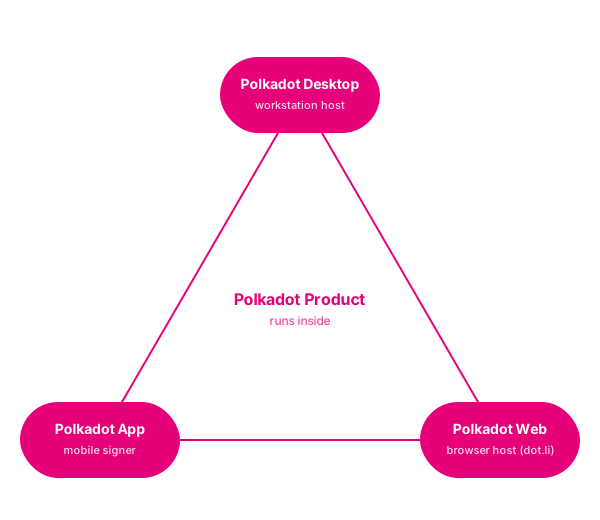
For the architectural breakdown covering how the Product, SDK, Host, and Polkadot infrastructure relate, see the App Development Reference.
Why Build a Polkadot Product?
Polkadot Apps is a complete environment for building Web3 decentralized applications:
Wallet built-in: The Polkadot App on the user's phone is the wallet for every Polkadot Product they use. No wallet integration code, no "Connect Wallet" button to design, no signing plumbing to maintain. Your Product receives a derived per-user account and asks for signatures; approvals happen on the user's phone.
Identity built-in: Per-Product accounts are derived from the user's .dot identity, so there is no signup flow. With Proof of Personhood, you can gate features on verified-human status without seeing who the user is, a privacy-preserving humans-only access model built into the platform. Need to recognize the same user across two of your Products? Same alias system, scoped to your Product set.
Decentralized hosting: Your bundle lives on a decentralized cloud storage provider. Your .dot name lives in a decentralized name service. There is no centralized hosting provider, no DNS service, no platform in the middle. Users fetch your Product directly and verify it themselves.
Product SDK: The Product SDK covers what you would otherwise integrate yourself:
- Chain access: Query state and submit transactions through the Host. No RPC servers to operate; signing prompts open on the user's phone.
- Decentralized storage: Upload files, get a permanent content-addressed URL.
- Real-time signed messaging: Pub/sub between users of your Product via the Statement Store, every message verifiable.
- Privacy-preserving payments: Request, top up, track status. Built on Coinage.
- Chat: Rooms, bots, interactive action buttons.
- Identity: Derived per-Product accounts, plus optional Proof of Personhood gating.
- Local storage: Per-Product key/value, persisted on the user's device.
Permissions (microphone access, outbound network requests, on-chain transaction submission, and more) are declared in your Product's manifest and prompted at runtime. Users see exactly what your Product can access before they grant it. The Host enforces the boundary inside its sandbox, not your code.
Three Hosts, one Product: The same .dot bundle runs in the mobile Polkadot App, on the workstation in Polkadot Desktop, and in any browser via Polkadot Web. You do not write three apps; the Triangle abstracts the platform.
| Created: June 16, 2026